

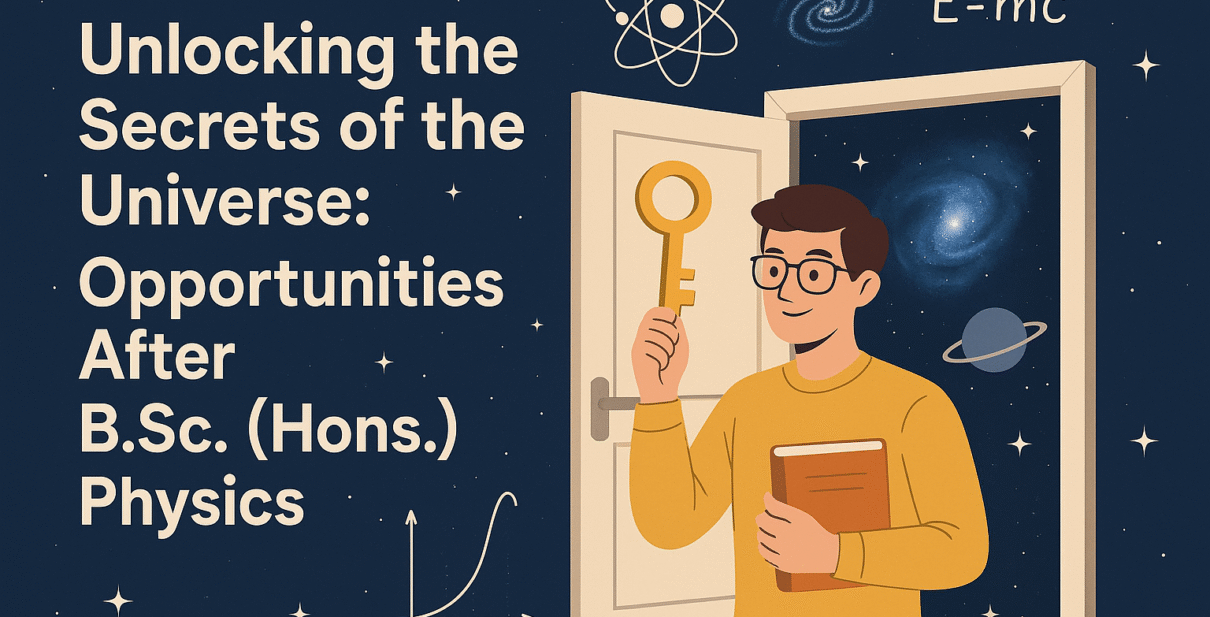
Physics is often described as the “queen of sciences,” and for good reason. It is the foundation of every scientific discovery, from understanding the behavior of atoms to unraveling the mysteries of galaxies. A B.Sc. (Hons.) Physics degree is more than just an academic milestone—it is an entryway into a universe of opportunities. If you are passionate about problem-solving, curious about how the world works, and eager to contribute to innovation, this degree can set you on an extraordinary path.
In this blog, we will explore the career scope, higher study options, and diverse opportunities that await after completing B.Sc. (Hons.) Physics.
Why Choose B.Sc. (Hons.) Physics?
Physics is not limited to equations and experiments; it nurtures analytical thinking, logical reasoning, and computational skills. Employers across industries value physics graduates because they possess:
-
Strong mathematical and problem-solving abilities.
-
Technical expertise in handling advanced equipment and software.
-
A deep understanding of natural phenomena and scientific principles.
-
Adaptability to apply theoretical knowledge to real-world problems.
This versatility ensures that physics graduates are never confined to one career track—they can branch into academics, research, technology, finance, data science, and beyond.
Higher Education Pathways After B.Sc. (Hons.) Physics
For many students, higher studies open the door to specialized knowledge and advanced career roles. Popular options include:
1. M.Sc. Physics
The most common pathway, an M.Sc. in Physics, allows specialization in areas like:
-
Astrophysics
-
Nuclear Physics
-
Particle Physics
-
Solid-State Physics
-
Quantum Mechanics
Graduates can pursue teaching, research, or enter national laboratories.
2. M.Tech / Engineering Pathways
With physics as a foundation, students can shift into applied sciences such as:
-
Electronics
-
Nanotechnology
-
Material Science
-
Renewable Energy
These domains combine engineering with physics, opening opportunities in industries and R&D centers.
3. Interdisciplinary Fields
Physics often merges with other disciplines, leading to careers in:
-
Geophysics (studying Earth’s physical properties)
-
Biophysics (intersection of biology and physics)
-
Medical Physics (application of physics in healthcare, especially radiology and imaging)
4. Management and Civil Services
Many physics graduates also pursue MBA programs or UPSC/Civil Services, blending their analytical mindset with leadership or administrative roles.
See more The Hidden World of Microbes: How They Shape Our Lives
Unlocking the Fascinating World of B.Sc. Psychology (Hons.): A Guide for Curious Minds
Career Prospects after B.Sc. (Hons.) Physics
1. Research and Development (R&D)
They can go for research posts in institutions like:
-
Bhabha Atomic Research Centre (BARC)
-
Defence Research and Development Organization (DRDO)
-
Indian Space Research Organization (ISRO)
-
Council of Scientific and Industrial Research (CSIR)
There, they may work on space technology, defense, energy, and advanced materials-based projects.
2. Academia and Teaching
Teaching is an extremely prestigious profession. With a master’s and qualifying exams such as NET/JRF or SET, the graduate can be appointed to teach in colleges and universities. For the school level, physics teachers never lack job opportunities.
3. Data Science and Analytics
Physics graduates are well trained in data analysis because they have a mathematical background. IT firms, finance firms, and consultancy firms directly employ them as data analysts, business analysts, or machine learning professionals.
4. Space and Astronomy
ISRO, NASA, and foreign observatories are the employers of students who want to study stars, galaxies, and cosmological events. A job opportunity as an astronomer or space scientist can be opened through the field of astrophysics.
5. Medical and Healthcare Physics
Physics lies at the heart of contemporary medicine. Sub-specialisation, one can specialize as:
-
Radiation therapy
-
Medical imaging (X-rays, MRI, CT scans)
-
Healthcare technology firms
6. Private Sector Job
Physics students are also lovingly welcomed in areas such as:
-
Electronics and Semiconductor Manufacturing
-
Energy (nuclear and renewable)
-
Aerospace and Aviation
-
IT and Software Development
7. Government Tests and Services
Physics students can prepare themselves to write government exams such as SSC, UPSC, RBI, and public sector undertakings (PSUs). Physics gives a mental advantage in exams with logical reasoning and problem-solving skills.
Entrepreneurial Opportunities
With scientific knowledge and creativity at hand, physics students can become great entrepreneurs. Opportunities like renewable energy business, the manufacture of scientific equipment, and edtech are vast.
Advantageous Skills for Physics Graduates
To survive in today’s workplace, physics students must learn some more skills including:
-
Data Visualization and Statistical Analysis
-
Communication and Presentation Skills
-
Laboratory and Research Techniques
-
Critical and Creative Thinking
These are not merely skills that make students job-ready but also equip them to be leaders in multisciplinary settings.
See more Why BBA is the Best Foundation for a Career in Business
Conclusion
It’s not about learning quantum mechanics or laws of motion—it’s about learning to think, create, and analyze. From understanding the secrets of the universe to developing technologies that will shape the future, physics graduates can become researchers, teachers, industrialists, or entrepreneurs. Essentially, studying this degree is to have an open treasure chest with ample opportunities, in which each career track opens up to the next opportunity to contribute to society. As long as your love for the universe has no bounds, so do the possibilities beyond B.Sc. (Hons.) Physics.
 Apply Now
 Fee Payment
 Admission
 Enquiry
 Quick Links