
- February 12, 2026
- by dibns-user
- News
- 33 Views
- 0 Comments
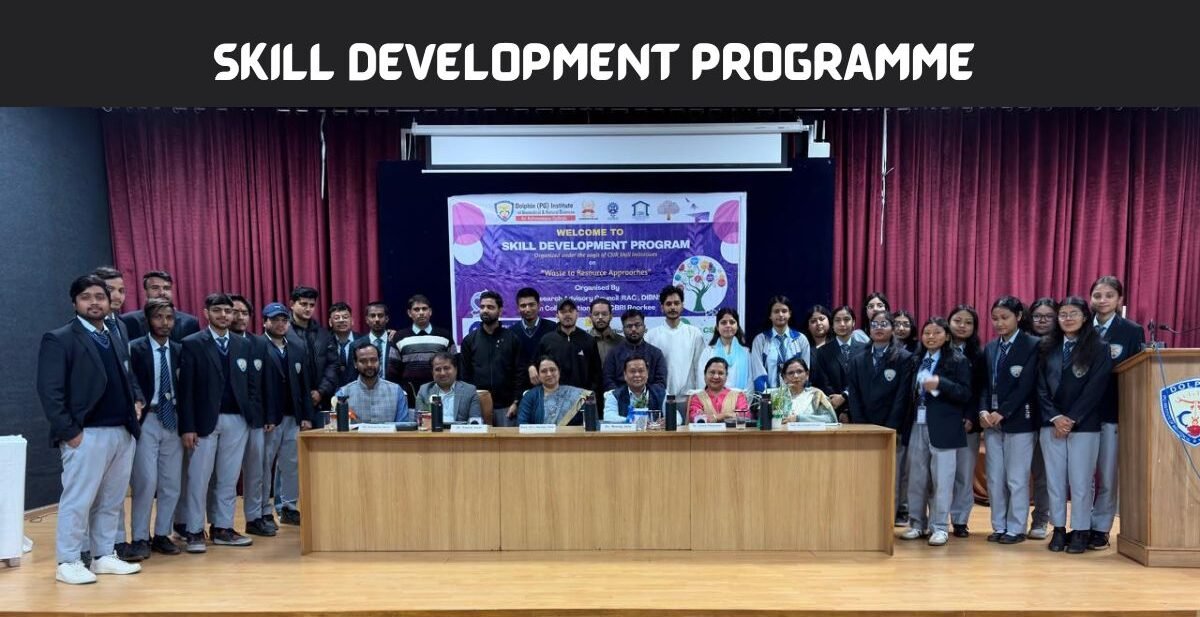
Dehradun, 12–13 February — Dolphin (PG) Institute of Biomedical & Natural Sciences (DIBNS), Dehradun, successfully organized a two-day Skill Development Programme on “Waste to Resource Approaches” on 12th and 13th February under the aegis of CSIR Skill Initiatives, in collaboration with CSIR–Central Building Research Institute (CBRI), Roorkee.
The programme began with a traditional lamp-lighting ceremony. Prof. (Dr.) Shailja Pant, Principal, DIBNS, welcomed the dignitaries and participants, highlighting the importance of skill-oriented and sustainability-driven education in addressing environmental challenges. Prof. (Dr.) Versha Parcha addressed the gathering and outlined the objectives of the programme, emphasizing its alignment with experiential learning and NEP 2020. The inaugural session was attended by Prof. Gyanendra Awasthi, Dean Academics; Dr. Shruti Sharma, IQAC Coordinator; Dr. Aasheesh Raturi, NEP Coordinator; and members of the Research Advisory Council (RAC) including Dr. Shalini Singh, Dr. Sandhya, Dr. Deepak, Dr. Virendra, and Dr. Ankur. The session was smoothly curated by Dr. Deepali.
The technical sessions on 12th February included an overview of CSIR-CBRI by Dr. Neeraj Jain, Senior Principal Scientist & Head (ODS), followed by a lecture on “Mineral Carbonation of Industrial Waste for Development of Sustainable Building Products” by Dr. Soumitra Maiti, Principal Scientist. Dr. Tabish Alam, Principal Scientist, delivered a lecture on the applications of solar energy, and Dr. Soumitra Maiti also presented a case study on integrated municipal solid waste management processing plants, demonstrating practical waste-to-resource models.
On 13th February, the programme continued with expert lectures by CSIR-CBRI scientists. Dr. Neeraj Jain delivered a lecture on “Waste Circularity: Low Carbon Plasters”, highlighting circular economy approaches in construction materials. Dr. Srinivas Rao Naik B., Principal Scientist, spoke on the application of agro-waste in cementitious materials with special reference to biochar, emphasizing resource efficiency. This was followed by Dr. Soumitra Maiti, who presented an in-depth case study on municipal solid waste management in an integrated processing plant. The concluding lecture was delivered by Dr. Payal Bakshi, Research Associate, CSIR-CBRI, on “Life Cycle Assessments to Achieve Net Zero Carbon Emission”, underlining the importance of sustainability assessment tools.
At the conclusion of the programme, feedback from participants was collected, and An assessment sheet was circulated to systematically assess participants;s learning outcomes, providing measurable insights into the knowledge and skills acquired by students over the two-day workshop. Certificates of participation were awarded to all participants, marking the successful completion of the programme.
The workshop reaffirmed DIBNS’s commitment to skill-based, experiential education, aligned with NEP 2020 and national sustainability goals.
 Apply Now
 Fee Payment
 Admission
 Enquiry
 Quick Links