

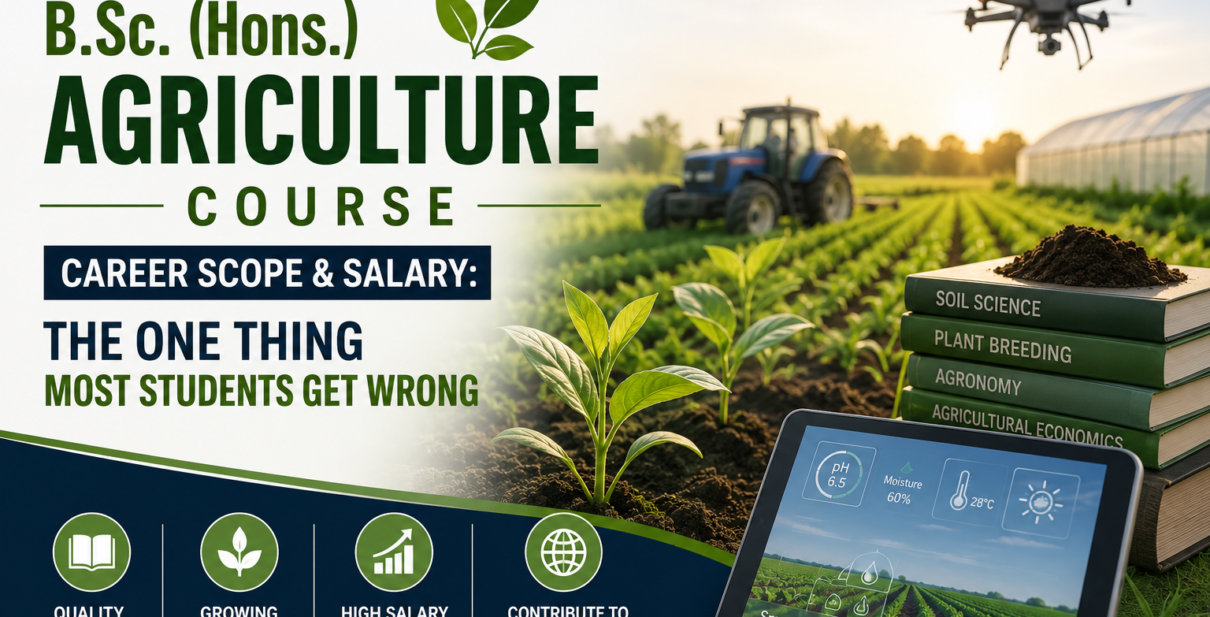
When students hear the word Agriculture, many immediately assume that the course is only for those who want to become farmers. This misconception causes thousands of students to overlook one of the fastest-growing and most rewarding professional fields in India.
The reality is very different.
Today’s agriculture sector is powered by modern science, artificial intelligence (AI), drones, biotechnology, precision farming, data analytics, climate-smart agriculture, food technology, and agribusiness management. Agriculture graduates are employed in multinational companies, research organizations, government departments, banks, food processing industries, seed companies, and agri-tech startups. Many also become successful entrepreneurs by starting their own farming, nursery, dairy, organic food, or agri-consultancy businesses.
If you are planning your future after Class 12, this comprehensive guide will help you understand why B.Sc. (Hons.) Agriculture is becoming one of the most preferred career options.
What is B.Sc. (Hons.) Agriculture?
Bachelor of Science (Honours) in Agriculture is a four-year undergraduate professional degree that focuses on scientific farming, crop production, soil management, plant breeding, agricultural technology, agribusiness, and sustainable agriculture.
Unlike traditional farming, this course teaches students how to increase productivity using scientific methods, modern equipment, research, and technology. Students gain practical exposure through laboratory experiments, field visits, internships, rural agricultural work experience, and research projects.
The course develops a strong understanding of agriculture while preparing students for careers in government organizations, private industries, research institutions, higher education, and entrepreneurship.
Why Agriculture is Becoming One of the Best Career Choices
India is an agricultural nation, and the sector contributes significantly to the country’s economy. However, agriculture today is no longer limited to growing crops. It has evolved into a technology-driven industry that requires skilled professionals.
Several factors are driving the demand for agriculture graduates:
- Increasing population and food demand
- Smart farming technologies
- Precision agriculture
- Organic farming
- Food processing industries
- Climate change management
- Government agricultural schemes
- Export opportunities
- Agri-tech startups
- Sustainable farming practices
Because of these developments, agriculture professionals are required in both rural and urban sectors.
More read: Best 12 Agriculture Courses After Class 12th in India
Eligibility Criteria
Students who have completed 10+2 (Intermediate) from a recognized board with Science subjects are eligible for admission.
Generally accepted streams include:
- Physics, Chemistry and Biology (PCB)
- Physics, Chemistry and Mathematics (PCM)
- Agriculture stream (where applicable)
Different universities may have their own eligibility criteria and admission process.
Course Duration
- Duration: 4 Years
- Semesters: 8
- Internships: Included in many universities
- Field Training: Practical agricultural training throughout the course
The curriculum combines classroom learning with practical field experience to help students develop industry-ready skills.
Subjects Covered in B.Sc. (Hons.) Agriculture
The syllabus is designed to provide knowledge of agriculture from basic to advanced levels.
Some of the important subjects include:
- Agronomy
- Soil Science
- Agricultural Chemistry
- Plant Pathology
- Agricultural Microbiology
- Genetics and Plant Breeding
- Horticulture
- Entomology
- Agricultural Economics
- Irrigation Management
- Seed Technology
- Crop Physiology
- Agricultural Extension Education
- Food Processing
- Farm Machinery
- Animal Husbandry
- Agricultural Biotechnology
- Agricultural Marketing
- Organic Farming
- Sustainable Agriculture
These subjects help students understand both theoretical concepts and practical agricultural applications.
Practical Learning
One of the biggest advantages of this course is the emphasis on practical education.
Students participate in:
- Laboratory practicals
- Crop cultivation
- Soil testing
- Plant disease diagnosis
- Nursery management
- Farm management
- Agricultural surveys
- Industrial visits
- Research projects
- Rural Agricultural Work Experience (RAWE)
- Internship programs
These activities help students gain confidence before entering the professional world.
Skills You Develop During the Course
The course develops several valuable professional skills, including:
- Scientific thinking
- Analytical skills
- Leadership
- Farm management
- Research methodology
- Communication skills
- Problem-solving
- Agribusiness planning
- Decision-making
- Teamwork
- Data interpretation
- Sustainable agriculture practices
These skills are useful across multiple industries.
Career Scope After B.Sc. (Hons.) Agriculture
This is where most students underestimate the degree.
Agriculture graduates have opportunities in government departments, research institutes, private companies, financial institutions, multinational corporations, and startups.
Some of the popular career options include:
Government Sector
Government organizations regularly recruit agriculture graduates for positions such as:
- Agriculture Officer
- Agricultural Development Officer
- Block Agriculture Officer
- Agriculture Extension Officer
- Food Safety Officer
- Seed Inspector
- Agricultural Research Assistant
- Rural Development Officer
- Horticulture Officer
- Soil Conservation Officer
Students can also prepare for examinations conducted by:
- NABARD
- IBPS Agriculture Field Officer
- Food Corporation of India (FCI)
- State Public Service Commissions
- Agricultural Universities
- ICAR Institutions
Government jobs offer attractive salaries, job security, allowances, pension benefits, and career growth.
Private Sector Opportunities
Private companies are increasingly hiring agriculture graduates due to technological advancements.
Popular job roles include:
- Agronomist
- Farm Manager
- Production Executive
- Quality Control Officer
- Food Safety Executive
- Seed Production Officer
- Fertilizer Marketing Executive
- Agricultural Sales Officer
- Supply Chain Executive
- Research Associate
- Crop Advisor
- Precision Farming Specialist
- Greenhouse Manager
- Plantation Manager
Leading industries recruiting agriculture graduates include:
- Seed companies
- Fertilizer industries
- Food processing companies
- Agri-tech startups
- Biotechnology companies
- Dairy industries
- Export companies
- Irrigation companies
- Agricultural equipment manufacturers
Entrepreneurship Opportunities
Agriculture offers one of the widest opportunities for self-employment.
Graduates can establish businesses such as:
- Organic Farming
- Mushroom Farming
- Hydroponic Farming
- Vertical Farming
- Dairy Farming
- Poultry Farming
- Goat Farming
- Bee Keeping
- Nursery Business
- Seed Production
- Agri Consultancy
- Fertilizer Distribution
- Floriculture
- Medicinal Plant Cultivation
- Food Processing Unit
With proper planning and government support schemes, many agriculture graduates become successful entrepreneurs.
Higher Education Options
Students who wish to continue their education can pursue:
- M.Sc. Agriculture
- MBA in Agribusiness Management
- M.Tech Agricultural Engineering
- M.Sc. Horticulture
- M.Sc. Plant Pathology
- M.Sc. Genetics and Plant Breeding
- Ph.D. Agriculture
Higher education opens opportunities in teaching, research, policy making, and specialized industries.
Salary After B.Sc. Agriculture
Salary depends upon job role, organization, experience, and skills.
Freshers
₹3–6 LPA
2–5 Years Experience
₹5–9 LPA
Experienced Professionals
₹10–20+ LPA
Professionals working in multinational companies, research organizations, agribusiness firms, or international projects often earn significantly higher salaries.
Entrepreneurs may earn much more depending on the scale and success of their business.
Future Scope of Agriculture
Agriculture is expected to become even more technology-driven in the coming years.
Emerging fields include:
- Artificial Intelligence in Agriculture
- Drone Technology
- Smart Irrigation Systems
- GIS Mapping
- Precision Farming
- Organic Farming
- Climate Smart Agriculture
- Agricultural Data Analytics
- Agri Robotics
- Sustainable Food Production
These innovations will continue to create new employment opportunities for skilled graduates.
Who Should Choose B.Sc. Agriculture?
This course is suitable for students who:
- Enjoy Biology and Environmental Science
- Want a government job
- Wish to work in research
- Are interested in food production
- Want to become entrepreneurs
- Enjoy outdoor and practical learning
- Wish to contribute to sustainable development
- Want a professional career with long-term growth
The Biggest Myth Students Should Ignore
One of the most common misconceptions is:
“B.Sc. Agriculture is only for becoming a farmer.”
This is completely incorrect.
Modern agriculture graduates work in research laboratories, banks, multinational companies, food industries, biotechnology firms, universities, government departments, NGOs, agri-tech startups, and international organizations.
The course is designed to prepare professionals, scientists, researchers, managers, consultants, and entrepreneurs—not just farmers.
Why Choose Dolphin (PG) Institute of Biomedical & Natural Sciences, Dehradun?
Choosing the right college is as important as choosing the right course.
At Dolphin (PG) Institute of Biomedical & Natural Sciences, Dehradun, students receive a balanced combination of academic excellence and practical learning.
Highlights
- Experienced faculty members
- Well-equipped laboratories
- Practical field training
- Research-oriented education
- Modern teaching methodology
- Industry interaction
- Career guidance and placement support
- Personality development programs
- Educational tours and field visits
- Internship opportunities
The institute focuses on preparing students for successful careers in agriculture, research, government services, and agribusiness.
Frequently Asked Questions (FAQs)
Is B.Sc. (Hons.) Agriculture a professional degree?
Yes. It is a professional undergraduate program recognized for careers in agriculture, research, agribusiness, government services, and higher education.
Can I get a government job after B.Sc. Agriculture?
Yes. Graduates are eligible for several government departments, public sector organizations, agricultural banks, research institutions, and competitive examinations.
What is the duration of the course?
The course duration is 4 years, divided into 8 semesters.
Is Agriculture still a good career?
The increasing demand for food security, sustainable farming, agri-tech, biotechnology, and precision agriculture makes it one of the most promising career options.
What is the average salary after B.Sc. Agriculture?
Fresh graduates generally earn between ₹3–6 LPA, while experienced professionals can earn ₹10–20 LPA or more, depending on their specialization and organization.
 Apply Now
 Fee Payment
 Admission
 Enquiry
 Quick Links